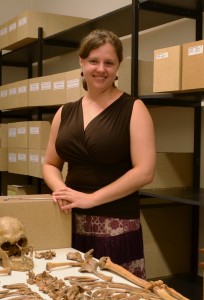
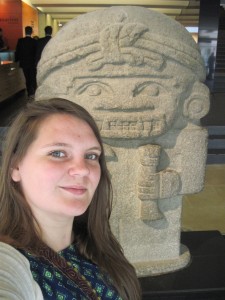
Alanna Warner (left) and Lauren Hosek (right), both graduate students at Syracuse University, were awarded the 2014 Biological Anthropology Section Student Prize. Warner and Hosek co-organized a symposium at the 2014 AAAs entitled, “The Bones and the Worms: Bioarchaeology as Microhistory.” The session brought together experts from across the breadth of bioarchaeology to examine how details of individual lives can be gleaned from bioarchaeological material. Within the symposium, Warner and Hosek presented their own paper, “Enamel, Stone, and Gold: Probing Composite Mouths and Personhood in Nineteenth Century New York City.” In this paper, Warner and Hosek explored how different dental prostheses provide a window into the way individual remains integrate intimate personal, but also broader, contextual experience. Ashley Marie Franklin from Louisiana State University was awarded honorable mention. The complete abstracts can be seen below:
Enamel, Stone, and Gold: Probing Composite Mouths and Personhood in Nineteenth Century New York City
Alanna Warner (Syracuse University) and Lauren Hosek (Syracuse University)
Bodies are not closed systems, but rather dynamic and permeable social entities composed of multiple materials and temporalities. As Ingold notes, bodies are “flow(s) of materials comprising corporeal life” (2011:16). Expressions of identity and formations of personhood are relational, generated and distributed through social interactions and material things. While this sense of relational, extended personhood is well attended to in prehistoric archaeology, historical archaeologists have engaged less with theories of personhood and tend to rely more on modern Western notions of bounded individuals and bodies (Wilkinson 2013; Fowler 2010). In this paper, we examine 19th century dental prostheses—a stone tooth, a gold bridge, and gold fillings—found with commingled skeletal remains in the Spring Street Presbyterian Church burial vaults (ca. 1820-1846) in New York City. A microhistorical analysis of these prostheses demonstrates how objects and substances are incorporated into bodies, becoming part of the overlapping processes and temporalities that make up corporeal life. The mouth is an especially active social interface where materials with biological and geological histories of their own intersect with experiences, habits, and practices. We examine the microscale entanglements of class, gender, medical practices, and ideologies of morality and aesthetics in the dynamic social landscape of 19th century New York City. Finally, we consider how the relational nature of bodies and materials allows personhood to be experienced, performed, and extended through a smile, a stone, or a glint of gold.
Comparison of Occlusal Area in Old and New World Monkeys: The Difference and Extra Premolar Makes
Ashley Marie Franklin (Louisiana State University)
This study considers the influence in number of premolars on postcanine occlusal area and mesiodistal length. New World (NW) monkeys have 12 premolars, whereas Old World (OW) monkeys have 8. Four species were studied: Cercopithecus albogularis and Colobus guereza (OW), and Cebus capucinus and Alouatta palliata (NW). Two pairs of species are classified as having the same general diet: Co. guereza and A. palliata, and Cer. albogularis and Ceb. capucinus. Adult, wild caught, female specimens from the Smithsonian National Museum of Natural History were studied. Sample sizes were as follows: 20 Co. guereza, A. palliata and Ceb. capucinus, and 14 Cer. albogularis . Measurements, using sliding calipers, included length and width of premolars and molars. Results show the percentage of contribution of premolars to total mesiodistal length of postcanine teeth and occlusal area in postcanine teeth differs between OW and NW monkeys. Premolars contribute 33% of postcanine length in both OW species, whereas the percentages are 40% for A. palliata and 48% for Ceb. capucinus. Results also show a difference in percentage contribution to occlusal area between OW and NW monkeys. There is an uneven premolar occlusal area distribution on both P3 and P4 in both OW species, in contrast to a more even premolar occlusal area distribution across P2, P3, and P4 in both NW species. This indicates not only a difference in the number of premolars, but also in the way premolar occlusal area is distributed between OW and NW monkeys.
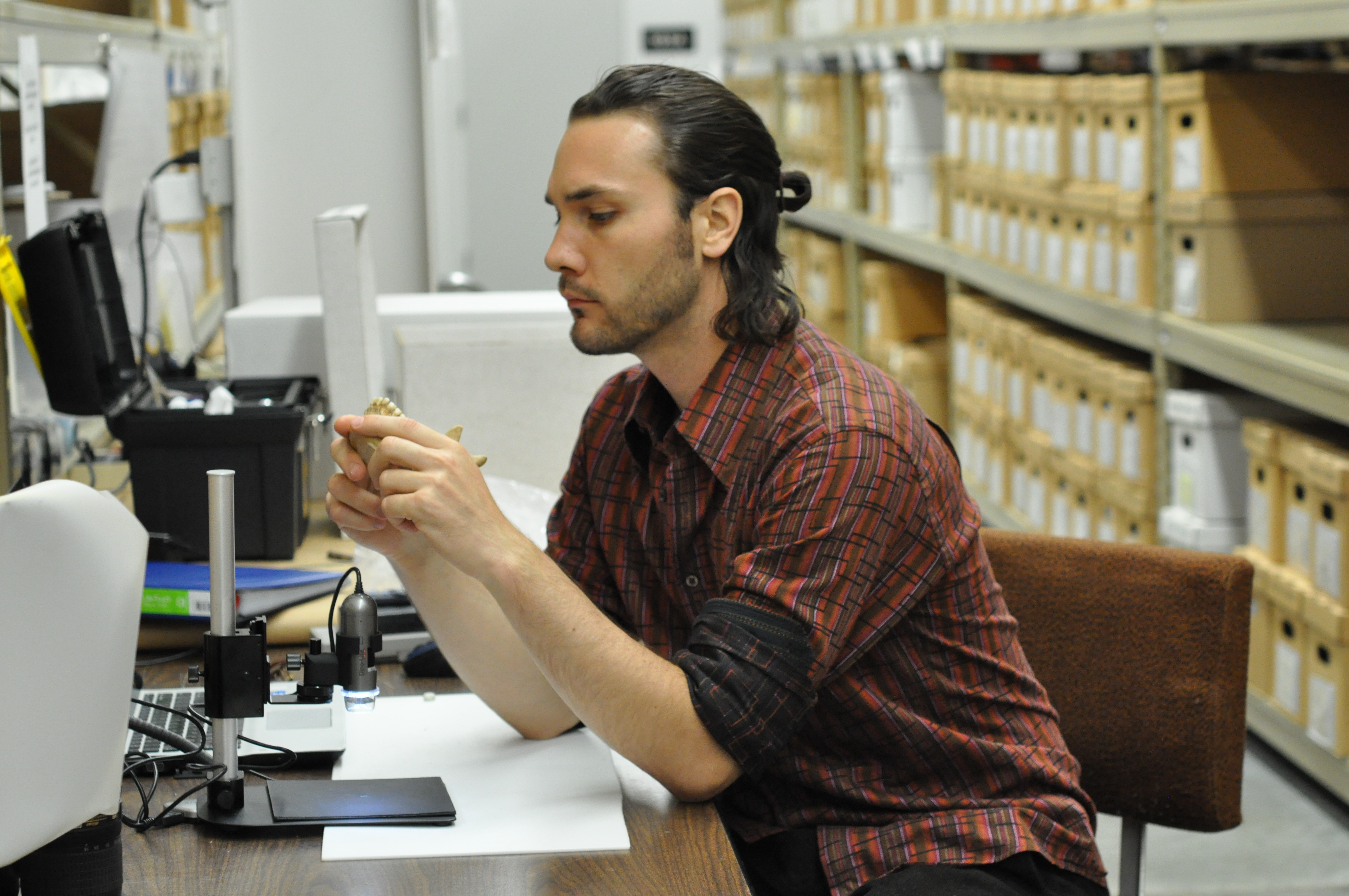
 The winner of the BAS Student Paper/Poster Award for 2013 is Marc Kissel (University of Wisconsin, Madison) for his paper, “Testing Genetic Models of Human Evolutionary History against the Anthropological Record.”